Diane Tulloch's exhibition "trace elements" is on show at the MacRobert Centre at Stirling University until 27th March 1999. She graduating B.A. (1st Class Hons.) from Duncan of Jordanstone College, Dundee, Diane was awarded the Farquhar Reid Award for Painting in 1995, and was highly commended at the Earth Arts exhibition at the Mall Galleries in London. Her exhibition "As Above, So Below" ran in February 1997 at the Cowane Centre, Stirling.
She has also shown in exhibitions of the Scottish Artist and Artist Craftsmen and Society of Scottish Artists, the Royal Scottish Academy Student exhibition, Compass Gallery "New Generation" and Collective Gallery "Showcase" exhibition.
Peter Russell interviewed her at the Cowane Gallery on 19th December 1996.
Working Conditions And The Future
How did you become an artist? What was your training?
From Denny High School, I went on to attend a two-year full-time course at Falkirk College of Technology (Diploma in Art/Design) specialising in Ceramics and Silversmithing. Then there was an eight year gap in which I worked in the Personnel Department at Viewforth, due to the lack of Art-related opportunities after Falkirk Tech. I continued to attend evening classes and Dollar Summer School during this time, until I applied to, and was accepted by, Dundee College of Art.
What is the inspiration for your work?
The natural environment. I always liked to go out walking and felt inspired by nature - not so much as "the landscape" but more looking straight down at the ground or up to the sky: macro- or micro-scopic. From childhood, I loved the Dochart River rock formations at Killin and especially the beach with its pebble scatter at places like the far North-West, Sutherland. And hillwalking - Munroes - in wilderness areas, Gairloch, Lochinvar.
What sources do you use? Drawing, photographic or texts?
Microscopic images, looking at cells, biological, plant-cells and geological structure. Stars and galaxies, using scientific instruments that are expanding the visual world. I take close-ups with the camera: pavement cracks, the land. Ideas come from walking and looking. Poetry, Zen poetry, Japanese gardens and literature (like the Diary of a Japanese Woman) pared down to essentials, the transience of life seen through nature.
Which artists have most influenced your development?
Hard to say; it changes all the time. Lucio Fontana - cutting/breaking through the picture plane, marks placed. Terry Winterson, Mark Wright - biological works. Antonio Tapies - the way he's developed, use of materials like marble dust, bitumen, both strong physicl sense and spiritual quality, but more chancy. But I also like the contemplative, minimal works of Agnes Martin, Barnet Newman (I saw an exhibition of his in London; I loved it: spiritual, less is more). Joseph Beuys, Kiefer - their alchemy and transformation. More elegaic, the outer reality leading inward, like a Noguchi house and garden with hand-picked stones to fit the motion of a stream.
How much has your home environment affected your work?
My family is very supportive, but there is space restriction as far as art goes. The financial side is a problem; there is a practical limit to buying paint and the difficulty is just to keep going. It's important to stick to a routine.
Did the industrial background of Bonnybridge have some influence?
Not in a direct way; there's no trace of the buildings or metals; but indirectly - I was always playing at the sand-quarry as a child.
Are your works specifically the works of a woman? Is there a feminine perspective?
Personally I don't think so - and a visitor to the Degree Show thought my work was done by a seven-foot ginger-bearded giant! In a way I can see why: working with plaster, chipping away on a big scale can seem masculine - a lot of elbow, that physicality in the making. There is no feminist agenda.
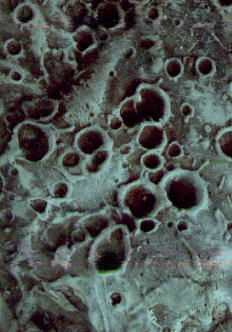
The smaller ones are the most recent, done working in a garage and governed by space limitations and the fearful cost of materials. The college work is bigger, chancier, subsidised. All pieces are from 1995-96.
Were they installed specifically for the Cowane Centre space?
No, yet the idea was in my mind; I knew the space. I wanted to alternate big, heavy works and smaller ones, to get more intimitely involved - so perhaps yes I did.
Looking now at individual works, is "Ad Infinitum" sculpture or painting? How did it evolve? What materials were used?
Can I say both? There's the objectiveness of it - the sand is taken round the edges - yet the traditional painting format - flat, on the wall, so it's a painting but also an object. It goes back to visiting beaches: looking at the ground, straight down at small spaces. I think I started looking at worm-holes, with small shells and pebbles scattered on the sand. They seem random but are composed through the camera viewfinder and the resulting photographs. Yet it could be any stretch of sand; there are no boundaries. (The title usually comes after, to give an idea to the viewer, while it should still be open to different readings.)
The form came through working with different materials - testing, puncturing - holes in the snow, then photographed. I wanted it to be ambiguous whether the embedded shapes are stars or pebbles. I didn't choose the colour specifically - the buzz came from almost accidental colour which then seemed inevitable. Working through experiment with all these different materials, I wanted to produce a large-scale version after the initial small piece, about 3ft by 2ft. A large-scale would give more impact, aplying the lessons of the test-piece.
The type of sand was important - East coast sand with particular colour and texture. The best was from Broughty Ferry, very gritty and yellowish. I felt that it gave a sense of place to the work, linking it to its original environment.
Describe the approach to "Continuum". When do you see it as finished?
I was experimenting with plaster, enjoying highly-textured surfaces. Also, I was looking at cell structures with branching effect and constructing their shape as a polystyrene framework (which is underneath the plaster). Their form came from microbiology books, tree roots, branches like arteries - the connectedness was the effect of books on Chaos Theory, fractals. I felt the shape was too structured, an idea that lacked the chance element. It really didn't work until I explored the Gestalt - where things flow - and roughly poured plaster over the surface. I started to enjoy the chance, chaotic element.
It's difficult to say when it's finished. You could say it's finished when it's not finished - it has to be open - as though you can go on but would lose that balance.
Yes, you can see things like rock, lunar surface, but I didn't want to mimic anything, to just be materials, pigment, bubble.
Please choose another work to discuss in terms of development...
"As Above, So Below", two of the last things I did, are interesting because, unusually, I had the title in mind first. The materials I chose were blackboard paint, aluminium paint and varnish, and I did a lot of experimenting. I found that I had to hold back from trying to control - so tipping paint into paint worked for itself and was not contrived.
"As Above", the top one, is almost skylike. It's light and airy, with a horizontal flow, whereas "So Below" is sinking, dripping paint with a downward pull, gravity.
The work is more literally based in its title than most; it has a theme, and I was aesthetically pleased with the form. Then again, the chance thing had taken over again. I want to carry on using paint more, the flowing liquid, bubbling and cracking, rather than heavy textured works. Maybe because I've worked so much in that way, I needed to diversify into paint.
Looking at the smaller works, are the "Strange Attractors" recent ones? What is their history?
The oldest works were showing polarities, and these were the first that got on this track. You could call them abstract, but I'm not so sure that is right - they are environmental. They seemed suddenly closer to realising ideas that I was working on. I did them with the canvas nailed to the table, as I would make different textures until things emerged. Although they are loosely worked, once they become these two fence-posts, old sticks, the black shiny paint was used to contain the colour-rich bands. The likeness to bore-samples fits with a study of geology books; clay soil strata may have influenced them. I used a heat-gun on raw pigment to achieve the lichen-like surface towards the top, and lenjoyed the alchemical mixing of materials. Things were still chancy till the end, chaos balancing order until the presentation as a magnetic tension.
Perhaps surface is more significant than image in your work. Is this transitional? Or a fixed state?
I don't want to be completely surface. I do want some theme or idea, something that you can push and pull to see how far you can take it, so that it looks orderly but there is a tension between order and chaos. I must always go back to something as a stimulus - the environment, a pattern or a system - but I wonder how to refine other ways to express these ideas.
I enjoy series of works, each one setting each other off, playing out the possiilities of a theme. Groups of works are about presentation of these possibilities. There are a lot of blind alleys, you sometimes feel the direction is wrong, but other times find a simple way of getting across, when you focus on one aspect - dots, say: how do you develop that? It can keep you going for years.
I work in a garage, which is impractical in extreme winter weather! It's a good space where I could be free to mess about, and suits me for the time being, but I find it a bit insular and difficult to look at work objectively after a while. At college you could bounce ideas off each other. I think some kind of joint studio set-up with other artists would be ideal.
Do you expect to stay in Bonnybridge?
I'd like to go up the West Coast to live. But I need also to look at things like foreign travel; it would be great to get a residency. I applied for the J.D. Fergusson Award in Perth, but the exhibition has taken up so much of my time and energy that I haven't much time yet to apply to competitions, nor to apply for a bursary towards new work. I've thought of taking a job. I need money to support all the materials needed to continue with my work. It's a bind, the time/money problem. Is it a career? The work is so sporadic, beset with financial difficulties, studio accomodatioon, all these things. I see I'm going to have to think of all the practicalities. I want to continue to develop as an artist. I cannot stop now, because I've never reached the "done it" stage and don't expect to.
Diane, many thanks for your generous time in submitting to this interview.
You're welcome. Apologies for rambling!
Back to Stirling Marginal Review contents page